

Here’s something I say to almost every brand I work with for the first time.
“Your emails are getting attention. They’re just not making you money.”
That line lands hard. Because most brands aren’t struggling with visibility. They’re struggling with what happens after the open. And the uncomfortable part? Most of them have no idea. On the surface, everything looks fine.
Open rates are decent. The list is growing. Something goes out every week. Numbers come back. It looks like a working program.
So nobody asks the harder question. Is this actually driving revenue?
After 7+ years in email and $45M+ in revenue generated across DTC brands, I can tell you the gap between “we’re sending emails” and “email is performing” is wider than most teams realise. The brands sitting in that gap are the ones wondering why revenue has plateaued despite a program that looks healthy from the outside.
Most brands don’t have an email problem. They have a visibility problem. They can’t see it’s broken because they’re measuring the wrong things.
The signs your email marketing is underperforming
These aren’t vanity metrics or surface-level issues. These are the signals that tell you your email program is quietly leaking revenue. Every week, on every send.
01: You’re celebrating open rates
I worked with a mid-sized lifestyle and beauty brand doing around $25k–$40k a month. Their campaigns were averaging 30–35% open rates. They were genuinely happy with that number. From where they sat, email was working.
When I looked at actual performance, email was only contributing 12–15% of total revenue. Most of that came from occasional promotions, not any structured system. Click rates were sitting at 1–2%. Subject lines were doing their job. The emails after the open weren’t doing anything.
Once I reframed it from “your emails are getting opened” to “your emails aren’t turning attention into revenue,” it clicked. They’d been optimising for the entry point. The money was sitting in everything that came after it.
Open rates matter. But they’re the start of the conversation, not the end of it. The real question is always what happens after the open. That’s where most of the money is made. Or lost.
02: Your flows are set and forgotten
This is the one that destroys brands the most consistently. And it’s almost never intentional. It’s just what happens when flows get treated as a one-time setup rather than an active revenue channel.
I audited a DTC fashion and accessories brand that had all the right flows in place. Welcome, abandoned cart, post-purchase. On paper, they looked covered. When I opened them, the core sequences had been running 8–10 months without a single meaningful update. No copy refresh. No structural changes. No testing.
The welcome flow was offering a generic discount without actually introducing the brand. The abandoned cart emails were template-heavy with no urgency and no objection handling. Just “you left something behind,” repeated twice. Nothing reflected seasonal changes, new products, or updated positioning. Everyone got the same experience regardless of where they were in their journey.
It wasn’t broken. It was static. And that’s exactly where the lost revenue was hiding.
After rebuilding the flows with tighter messaging, clearer CTAs, and proper sequencing:

Not extreme numbers. But the flows were finally contributing consistently instead of just sitting in the background. If you can’t remember the last time you reviewed your flows, that is the sign.
03: Every campaign goes to your entire list
Same email. Same copy. Same offer. Sent to new subscribers, loyal five-time buyers, and people who haven’t opened in six months. All at once.
That’s not a campaign. That’s a broadcast.
Each of those groups has a completely different relationship with your brand. The message that converts a repeat buyer will confuse someone still deciding if they trust you. The urgency that re-engages a lapsed customer will feel aggressive to someone who signed up three days ago.
The brands I work with most often sit in the $20k–$100k a month range. They’re not doing this out of neglect. They’ve installed segmentation because they know they’re supposed to. But they send to the full list anyway because it’s faster, and open rates don’t look obviously broken. The problem is invisible until you pull revenue per recipient and see how much each segment is actually converting.
Blasting your entire list is one of the clearest signs your strategy is built around sending volume, not performance.
04: You send more emails when revenue slows
Revenue dips. Someone says “we need to do more email.” Frequency goes up. A few extra promotions land on the calendar. Nothing changes.
Because the problem was never frequency.
More sends to a broken program don’t fix the program. They exhaust your list faster, push deliverability in the wrong direction, and create a false sense of activity that covers the real issue.
If your first instinct when email underperforms is to send more, that instinct is costing you. The answer is almost never volume. It’s almost always structure.
05: Your campaigns and flows have no relationship
A customer buys. They enter your post-purchase flow. Three days later, a campaign fires with a discount on the product they just paid full price for.
Two separate things running in parallel with no awareness of each other.
When campaigns exist in isolation from your flows, the customer experience breaks down at exactly the moment it should be building trust. That has a direct impact on conversion. It just rarely gets identified as the reason numbers are soft.
If you want to understand how campaigns and flows should work together, I covered it in detail here: Why Email Campaigns Don’t Convert — And What’s Actually Breaking Your Revenue. The short version: campaigns don’t drive revenue alone. They amplify what your flows have already built. When the two aren’t connected, neither performs the way it should.
06: Your emails are beautifully designed and quietly underperforming
Stunning header. Branded colour palette. Multiple sections. Three CTAs because there were three things to say. And a click-to-conversion rate going nowhere.
Design doesn’t drive revenue. Clarity does.
The more visual complexity in an email, the more directions a reader gets pulled. Until they don’t move at all. Some of the highest-performing emails I’ve built across 3,000+ designs look almost plain. One message. One CTA. No competition for attention. When there’s nothing to look at, there’s only something to click.
The teams most proud of how their emails look are often the ones with the weakest conversion numbers. That’s not a coincidence.
07: You can’t tell which emails are actually driving purchases
You’re sending. Revenue is coming in. But you can’t point to a specific flow, campaign, or sequence and say: that’s the one doing the work.
That’s a measurement problem. And it’s more common than most teams admit.
Without knowing which emails are driving purchases versus which ones are just filling inboxes, you can’t make informed decisions. You’re optimising by feel. And optimising by feel in email is how good programs slowly drift into mediocre ones.
Revenue per campaign. Click-to-conversion rate. Attributed revenue per flow. If those numbers aren’t in your weekly review, you don’t have a clear picture of what’s actually working.
You can have 40% open rates and still massively underperform on revenue. If the message doesn’t connect, the offer isn’t clear, and the CTA doesn’t push action, opens mean nothing. Everything that matters happens after.
If more than two of these signs sound familiar, your email program has structural gaps. And those gaps are costing you revenue on every send.
I audit DTC email programs and show brands exactly where the leaks are. Not a pitch. A real look at your flows, your campaigns, and what’s quietly not working.
See how I work 
Why these signs are so easy to miss
Because email feels active even when it’s not performing. Something goes out. Numbers come back. There’s data on the screen. It looks like a working program.
But activity isn’t performance.
The metrics most brands default to — open rate, list size, send count — are all measures of activity, not outcomes. And most brands in the $20k–$100k range have never seen a properly structured email program generating consistent, attributable revenue. So the benchmark becomes “better than last month.” That’s a low bar. It hides a lot of structural problems for a long time.
They’ve installed flows because they’re supposed to. They send campaigns when they have something to promote. They check open rates and assume things are fine. The foundation is there. It’s just not being actively optimised or taken seriously as a profit driver.
How to fix email marketing that’s underperforming
Start with what you’re measuring
Before changing anything, change what you’re tracking. Pull revenue per campaign and revenue per flow. Click-to-conversion rate, not just click rate. Attributed revenue, not opens. This alone will show you which parts of your program are earning their place and which ones are just occupying space.
Audit your flows like they’re new
Open every active flow and read through it as if you’ve never seen it. Is the copy still accurate? Is the offer still live? Does the sequence still make sense for where the customer is right now? Flows decay. The sequence you built 10 months ago may not reflect your current brand, pricing, or product line. Treat them like something that needs regular attention, because they do.
Give every campaign one job
Before anything gets written, decide what this campaign is for. Conversion. Re-engagement. Retention. One campaign, one job. If it’s trying to do more than one thing, it’s not doing any of them well. The full breakdown of how to structure campaigns that actually drive revenue is here: Why Email Campaigns Don’t Convert — And What’s Actually Breaking Your Revenue.
Segment — even at a basic level
Customers vs. non-customers. Engaged vs. unengaged. Start there. Different copy, different offers, different urgency. Your campaigns start speaking to people instead of at them. The lift is immediate.
Connect campaigns to your flows
Map your active campaigns against your flows and ask one question: does this support the experience or interrupt it? The goal is a system where everything points at the same outcome. Not two separate programs running in parallel, hoping for the best.
You don’t fix underperforming email by sending more. You fix it by building better structure around what you’re already sending.
The numbers behind fixing it
Here’s what the shift looked like across one account after rebuilding flows, adding basic segmentation, and restructuring campaign strategy.
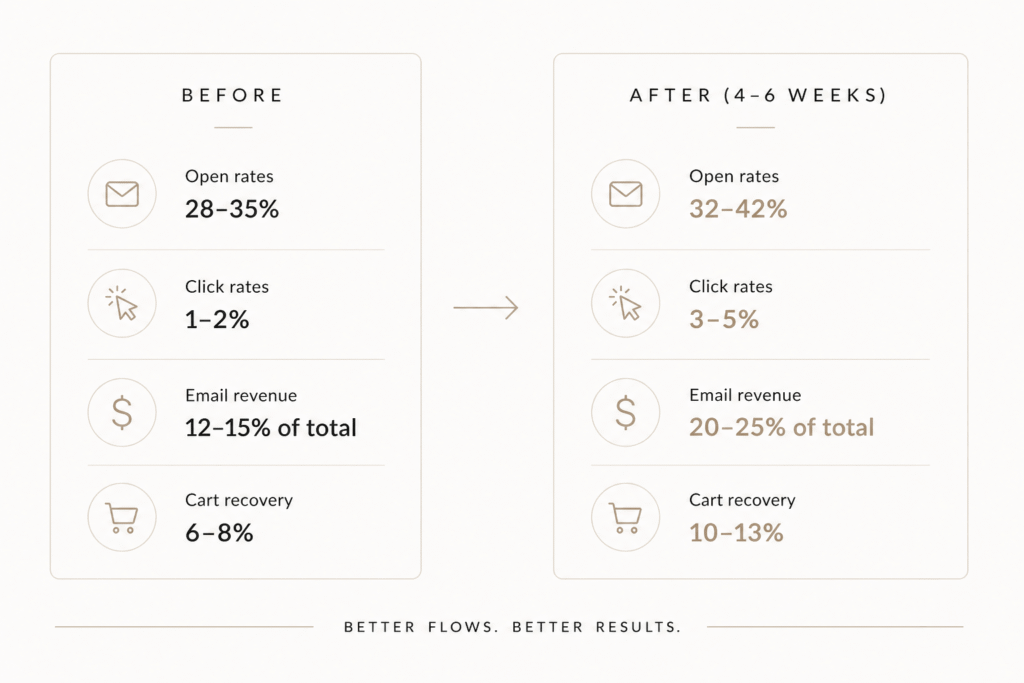
The open rate barely moved. Everything else did. That’s the point.
Final thought
If you recognised your program in this list, that’s not a failure. It’s a starting point. Most brands are running on default settings, measuring the wrong things, and assuming consistency equals performance.
It doesn’t. But it can, with the right structure behind it.
You probably don’t need more campaigns. You need to understand what your current ones are actually doing. Then build something intentional around that.
If your email program isn’t performing the way it should, I can take a look and show you exactly where the gaps are. No templates, no generic advice. A real read of your flows, your campaigns, and what’s quietly costing you revenue.
Built for DTC brands running on Klaviyo. 7+ years in email marketing. 3,000+ emails designed. $45M+ in revenue generated.


Leave a Reply