


The Real Problem With Email Campaigns That Don’t Drive Revenue
Let me tell you something most email marketers won’t say out loud.
You can send four campaigns a week, hit 40% open rates, and still be leaving the majority of your email revenue on the table.
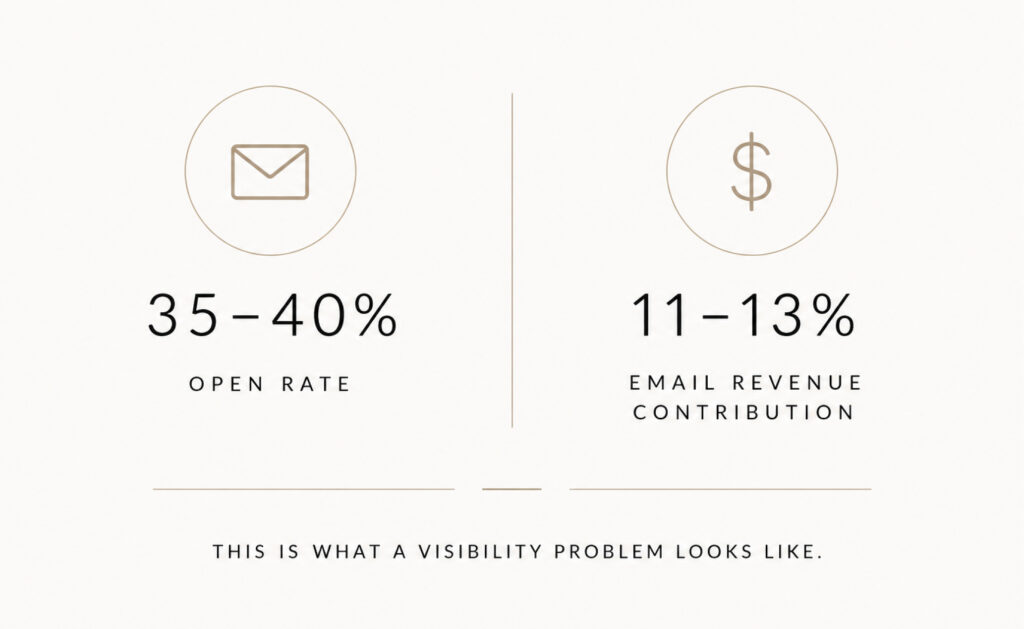
I know because I’ve seen it. A DTC skincare brand, $50k–$70k a month in revenue, reached out to me through LinkedIn. Their team felt good about email. Campaigns were going out consistently. Open rates were sitting at 35–40%. From where they were standing, things were working.
When I got into the account, the first thing I told them was this: “You’re sending a lot of emails, but you’re not really communicating with anyone.”
That landed.
Because despite sending three to four campaigns every week, email was driving only 11–13% of total store revenue. Click rates were stuck at 1–1.5%. Segmentation was almost nonexistent. And every campaign — different subject lines, same message — was going to the full list regardless of whether someone had bought five times or never opened an email.
They didn’t have an email problem. They had a strategy problem disguised as consistency.
Most brands don’t have a campaign problem. They have a performance problem, and sending more emails is how they avoid seeing it.
Why Email Campaigns Don’t Convert, The Real Causes
Seven years in email. $45M+ in revenue generated across DTC brands. The same patterns show up every time. They’re not complicated. They’re just consistently ignored.
1. No Connection to Your Flows or Lifecycle
Campaigns get built in a vacuum.
Someone writes a subject line, designs a template, picks a segment — usually the full list — hits send. Nobody asked where the customer is in their journey. Nobody checked what flow they’re currently in or what they received yesterday.
The skincare brand I mentioned? That was the core of their problem. Campaigns firing constantly, but none of them aware of what the automations were already doing. No coordination. No logic. Just volume.
When campaigns exist in isolation from your flows, the customer experience falls apart. And when the experience falls apart, conversion follows.
2. Generic Messaging That Tries to Speak to Everyone
Broad messaging is weak messaging.
One campaign. Same copy. Entire list. New subscribers who’ve never bought sitting in the same send as repeat customers on their fifth order. Lapsed users who haven’t opened in four months getting the same email as your most loyal buyers.
That email isn’t written for any of them. It connects with none of them.
The skincare brand’s campaigns looked different on the surface — new subject lines, new creative. But the message underneath was always the same. Different packaging, same broadcast.
Relevance is what drives clicks. And clicks are what drive revenue. Without segmentation, you’re just generating opens and wondering why nothing converts.
3. Design-First Thinking Instead of Conversion-First
A lot of email teams are proud of how their emails look.
They should spend less time on that.
Overdesigned emails create noise. Multiple sections, competing offers, heavy imagery, three different CTAs pulling the reader in different directions. By the time they’ve processed the email, they’ve already decided not to act.
The highest-converting emails I’ve built look almost plain. One message. One direction. One place to click.
When there’s nothing to distract, there’s only something to do.
4. No Clear Objective Per Campaign
What is this campaign actually for?
If the answer is “we had something to promote” — that’s not an objective. That’s a reason to send.
Most brands try to convert, engage, inform, and retain in a single email. The copy gets pulled in four directions. The CTA loses its edge. The reader has no clear idea what they’re supposed to do next.
One campaign. One job. That’s it. The moment you try to do more than one thing, you start failing at all of them.
If your campaign doesn’t have a single clear goal, it will not drive revenue. That’s pattern recognition from hundreds of accounts, not a theory.
5. Campaigns and Flows Fighting Each Other
This one is structural. And it’s the one most brands never catch.
The worst example I’ve seen was a fashion accessories brand. Good product. Solid team. Flows set up, campaigns running. On paper, everything looked active.
From the customer’s side, it was chaos.
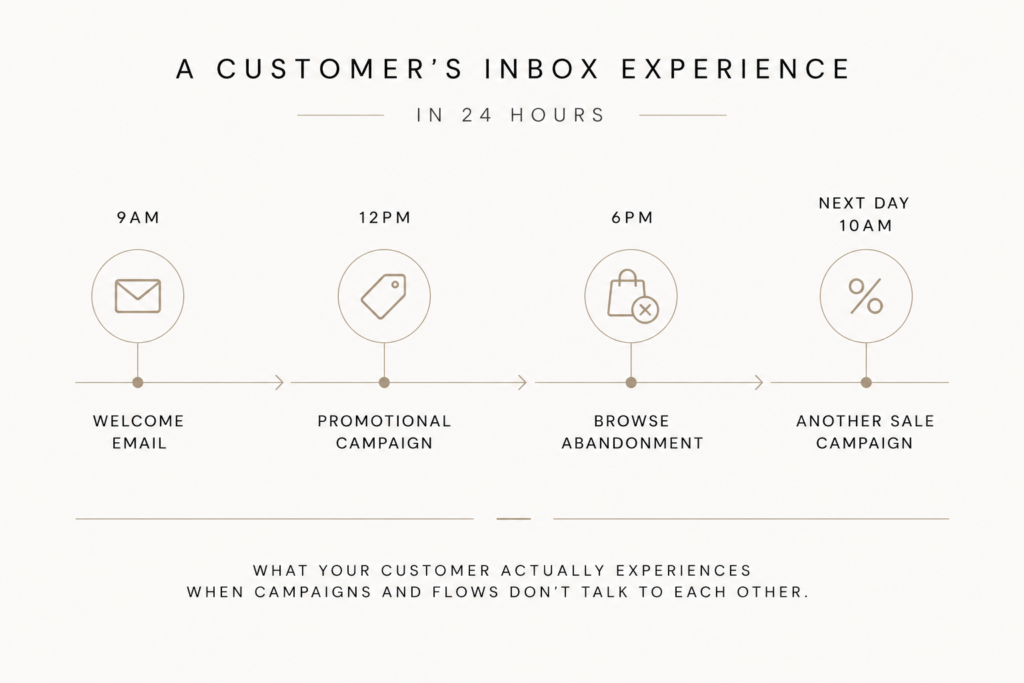
Someone signs up. Gets a welcome email in the morning. A promotional campaign at lunch. A browse abandonment email that evening. Another sale campaign the next day.
Four emails in 24 hours. None of them connected. None of them aware the others existed.
The flows were technically working. The campaigns were technically working. Together, they were creating an experience that damaged trust faster than it built it.
Once we cleaned up the logic — added flow filters, built suppression rules, got intentional about who received what and when — things shifted almost immediately. Customers were getting fewer emails overall. But the emails they got felt like they were written for them. Revenue became consistent because campaigns and automations were finally supporting each other instead of competing.
If this sounds familiar, your email system has gaps, and they’re costing you revenue every time you send. Here’s how I find them →
What High-Performing Email Campaigns Actually Do Differently
This isn’t theory. Here’s what separates campaigns that print money from campaigns that fill inboxes.
They’re Tied to Revenue, Not Just Scheduling
High-performing campaigns have a role. They’re not random promotions. They’re deliberate moves inside a larger system.
Before anything gets written, one question gets answered: what do we want the customer to do, and why now?
Everything else — copy, design, segment, send time — follows from that.
They’re Built Around Customer State
New subscriber. Repeat buyer. Lapsed customer. These aren’t just segments. They’re completely different conversations.
The message that converts someone who’s bought three times will fall flat on someone still deciding whether to trust you. High-performing campaigns meet customers where they actually are. Not where you wish they were.
They Support Flows. They Don’t Compete With Them
This is the piece most brands miss entirely.
Campaigns shouldn’t interrupt your flows. They should reinforce them. A campaign hitting someone mid-welcome series should feel like a natural continuation, not a random message from a brand that forgot what it already said.
Campaigns don’t drive revenue alone. They amplify what your flows have already built.
When you get that relationship right, the whole system compounds. Flows build the relationship. Campaigns monetize it.
How to Fix Email Campaigns That Aren’t Converting
No frameworks. No buzzwords. Here’s exactly what I’d do if I was auditing your account today.
Step 1 — Define a Single Goal Per Campaign
Before you write a word of copy, decide what this campaign is for.
- Conversion — drive a purchase
- Retention — reward or deepen loyalty
- Re-engagement — win back someone who’s gone cold
One campaign. One job. If it’s doing more than one thing, cut it until it isn’t.
Step 2 — Segment Properly (Even at a Basic Level)
You don’t need 40 segments. Start here:
- Engaged vs. unengaged — opened or clicked in the last 90 days vs. those who haven’t
- Customers vs. non-customers — people who’ve bought vs. people who haven’t
That’s it to start. Different copy, different offers, different urgency. Suddenly your campaigns are speaking to people instead of at them.
Step 3 — Simplify Your Emails
Cut the second CTA. Remove the extra section. Kill the banner nobody reads.
One message. One CTA. Make it impossible to misunderstand what you want them to do.
If your email takes more than a few seconds to figure out, it’s already losing.
Step 4 — Align Campaigns With Your Flows
Map your active campaigns against your live flows. Ask one question for each: does this support or interrupt?
Add suppression rules. Build communication logic. Make sure a customer who just entered a post-purchase flow isn’t getting hit with a promotional campaign about the product they just bought.
The experience on the receiving end matters. When it’s coherent, conversion improves. Every time.
Step 5 — Measure What Actually Matters
Stop reporting on open rates as a success metric.
Open rates tell you whether your subject line worked. That’s it. They don’t tell you whether the email made money.
Track these instead:
- Revenue per campaign — what did this send actually generate?
- Click-to-conversion rate — of everyone who clicked, how many bought?
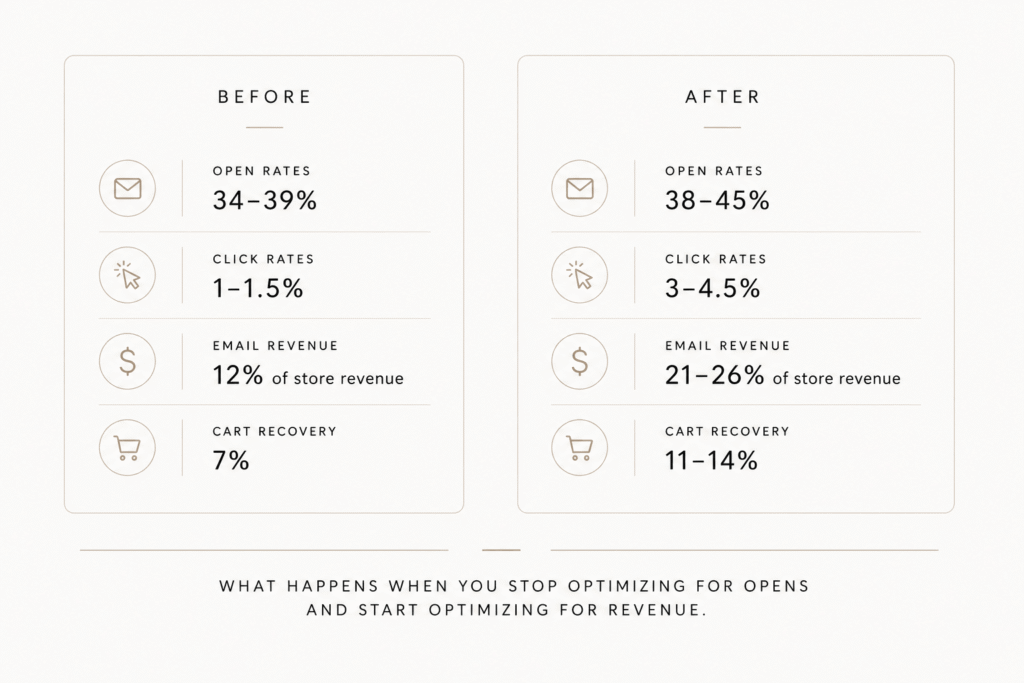
With the skincare brand, that shift in measurement alone changed everything. Once we stopped optimizing for opens and started tracking revenue per campaign, every decision got sharper. Within 30–45 days, email revenue contribution moved from 12% of total store revenue to 21–26%. Click rates went from 1–1.5% to 3–4.5%. Abandoned cart recovery climbed from 7% to 11–14%.
The opens barely moved. Everything else did.
If you’re tracking opens more than revenue, you’re optimizing the wrong metric and every decision you make from that data is slightly off.
The Shift Most Brands Need to Make
From Sending Emails → To Building a System
Campaigns are one piece. A promotion, a product launch, a re-engagement push — these are moments inside a larger structure.
Revenue doesn’t come from individual campaigns. It comes from a system where flows build relationships, campaigns create momentum, and everything is pointed at the same outcome.
Most DTC brands between $30k and $150k a month are stuck in between. Past the stage where every sale feels like a miracle. Not yet at the stage where systems run the channel. Sending plenty of emails. Very little of it connected by an actual strategy.
That’s the gap. And it’s a revenue gap, not a creative one.
From Design → To Performance
Good-looking emails that don’t convert are expensive decoration.
Design should serve the message. The message should serve the goal. The goal should always be tied to revenue.
When you flip that order — when design becomes the priority — you end up with beautiful emails that quietly underperform while the team congratulates itself on how clean the layout looks.
Most brands send campaigns. Very few build systems that drive revenue.
Final Thought
You probably don’t need more campaigns.
You need better structure behind the ones you’re already sending.
One clear goal. The right segment. A message that fits where the customer actually is. An email simple enough to act on. Metrics that tell you whether it worked.
That’s not complicated. It’s just disciplined — and most brands skip it.
If your campaigns aren’t performing the way they should, I can take a look and show you exactly where the gaps are. Not a sales call, a real look at your account, your flows, and what it’s costing you. Let’s talk


Leave a Reply